We hope you enjoy reading this blog post
If you need help with website or marketing, book a call with our team for a free 360° overview and actionable recommendations report. Book a call

If you need help with website or marketing, book a call with our team for a free 360° overview and actionable recommendations report. Book a call
A practical guide for small business owners who know they need a website refresh but aren’t sure where AI fits in
Most business websites are quietly losing customers every day. Not because the business is bad. Because the website was built for how people searched in 2017, not how they behave in 2026.
You already know that it is overdue for an upgrade, but maybe since everyone is on an AI trip now, it’s not worth it. Wrong. Dead wrong. Right now, your website might look like it was built in 2017 (also maybe because it was)/ it crawls like a sloth on mobile, and you have grown so much more since the launch. Putting the upgrade on the backbench will cost you.
But where does all this come in with all the new talk about AI? Did your website upgrade get more complicated because of it? Not at all. Getting your footing in this whole AI parade is important, but let’s work on learning more about what you need your website to do for you in the interim.
In this post, we’ll walk you through, as plainly as possible, how a website upgrade can benefit you in the age of AI.
For many business owners, having a website meant there was a place on the internet that showed their hours, address, and services. Also, a way to contact you. Most customers would have to search for more information about your business elsewhere.
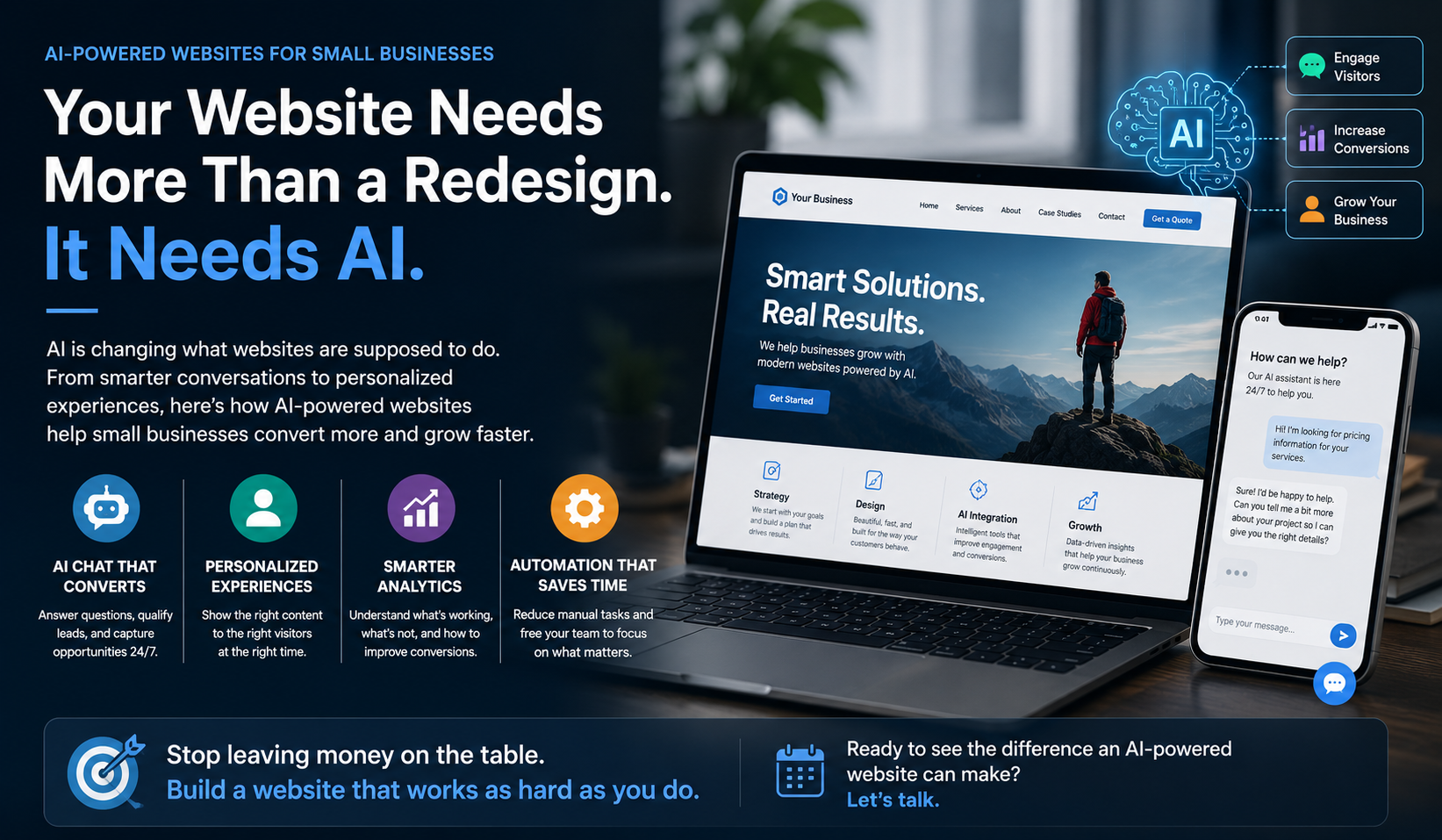
Now that has changed with AI, and in a big way. Your website is no longer a digital brochure. It is now expected to function like an active part of your business. It is expected to behave more like your most capable salesperson, available 24/7, responsive to what each visitor actually needs, and capable of turning interest into action, all without you being in the room or in front of the computer.
AI is what makes that shift possible at scale. Here’s how.
The most visible AI feature on modern websites is the chat function. But not the clunky, frustrating chatbots of five years ago that could only answer three questions before reaching a dead end. Today’s AI chat can:
For service-oriented businesses like a law firm, a landscaping company, or an accounting practice, this means a potential customer who lands on your site at 10 PM on a Sunday gets a real, helpful response. Not a form that sits in an inbox until Monday morning. AI chats convert visitors who would otherwise leave. It doesn’t replace your team; it handles the volume so your team can focus on the conversations that matter most.
After more than 15 years of building conversion-focused customer experiences, one thing has become very clear: in creating converting customer experiences, the same homepage shouldn’t show the same thing to every visitor. A first-time visitor who found you through a Google search for needs different information than someone who clicked a link in your email newsletter.
An AI-powered website can detect signals, where someone came from, what they’ve clicked on, how many times they’ve visited, and dynamically adjust what they see.
This could look like:
Personalization used to be a feature reserved for enterprise companies with large budgets. AI has changed that. The question now isn’t whether personalization is accessible to SMBs. The question is whether your current website is built to take advantage of it.
Most businesses already have analytics installed. Very few actually know what the data is telling them. Your current website probably has Google Analytics installed, and you might even check it occasionally. But most business owners either have no idea what they are seeing, and the raw traffic numbers don’t tell you much about why visitors leave. Or, what questions they can’t find answers to, or which pages are driving your actual business goals versus just attracting clicks.
Here’s what AI-powered analytics can show:
All of these matter because a website refresh without insight is just a redesign. You can spend significant money on a beautiful new site and still have the same conversion problems if you don’t understand what drove them in the first place.
Of course, most small businesses didn’t intend for their website to become outdated. The task feels like a second job. Updating service pages, writing new blog posts, and refreshing seasonal content; a set of tasks that most SMB owners simply don’t have time to do.
Bear in mind that AI doesn’t eliminate this, but it dramatically lowers the lift. AI-assisted content tools can:
This is relevant for SEO in particular. Google’s algorithm increasingly rewards websites that demonstrate genuine expertise and are regularly updated. AI makes it feasible to maintain that cadence even when you’re running a business with limited bandwidth.
The first step to an upgrade usually comes with questions about aesthetics. Questions like “What should my new site look like?” are less of a priority. Still a valid and required question, but in the age of AI, the better question is, “What should my new site do?”
A modern, AI-powered website is not primarily a visual update; this is a functional one. The design matters, but the more important question is whether your new site will:
These are not technical luxuries. They are the table stakes for what a competitive small business website looks like.
Here are some things to consider. Waiting for the right time to update your website puts you at a disadvantage, especially when they are already deploying AI-powered chat, personalization, and analytics on their websites. The gap this creates is not theoretical; it’s the difference between a business that captures a random Sunday night lead and one that loses it to a competitor who has a responsive site.
If your website is outdated, the goal isn’t just to make it look better. It’s to make it work harder — and smarter — for the business you’ve built.
That’s a distinction most agencies miss. They’ll give you a redesign. What you actually need is a strategy: one that starts with understanding how your customers find you, what they need when they arrive, and what’s standing between their first visit and a signed contract or booked appointment.
This is where WDB Agency is different.
When it comes to AI integration specifically, we don’t hand you a list of tools and leave you to figure it out. We help you identify which AI capabilities actually match your customer journey, implement them in a way that feels seamless to your visitors, and measure performance so you can see the impact. Whether that’s an AI chat that qualifies leads overnight, personalization that improves conversion, or analytics that finally tell you what your site is actually doing — we build it, configure it, and make sure your team knows how to use it.
Working with WDB means working with a team that speaks plainly, thinks strategically, and understands that execution matters more than hype.
The businesses gaining an advantage right now are not necessarily spending more. They are adapting faster.
That is what AI changes.
Ready to see what an AI-powered website could actually do for your business?
Contact WDB Agency today, and let’s start with a straightforward conversation about where your business stands, where you want it to go, and what it realistically takes to get there.


Please complete the form below and one of our team members will be in touch shortly.