We hope you enjoy reading this blog post
If you need help with website or marketing, book a call with our team for a free 360° overview and actionable recommendations report. Book a call

If you need help with website or marketing, book a call with our team for a free 360° overview and actionable recommendations report. Book a call
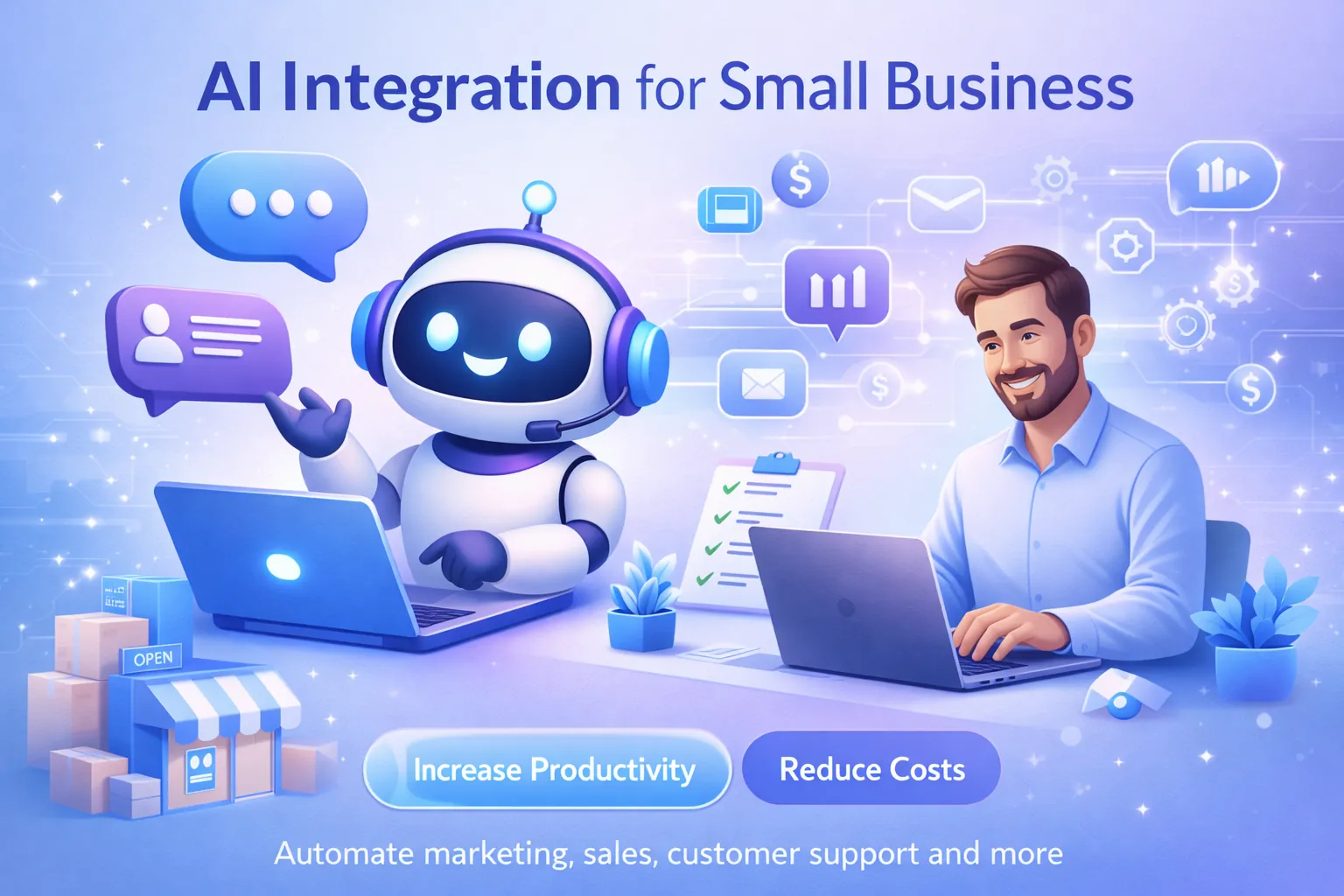
Now that the barrier to tools powered by artificial intelligence is non-existent, businesses of all sizes and profit margins are taking advantage. Between 2022 and 2024, the cost of running AI models dropped by roughly 90%, eliminating the need for in-house engineers. Tools with powerful AI capabilities now cost around $30 on subscription, which any small team can afford without a technical background.
The challenge isn’t finding AI tools. There are hundreds available. The real task is knowing which tools to use, how to integrate them into existing workflows, and how to build systems that improve business performance instead of adding digital clutter. This isn’t a gradual trend but a structural shift in who gets to use artificial intelligence. Small businesses fit squarely in that category.
The AI chatter, especially when it comes to consultations, is varied, and businesses are cautious. If the tools already exist, why do you need help with adoption? AI adoption is more than tools, and we explored much of this in your blog that deals with strategy to execution.
In this post, we guide you through some practical ways to improve your workflow and why partnering with a consulting firm can help with strategy.
The businesses that start building intelligent workflows now aren’t just becoming more efficient. They are building operational capacity that compounds over time. Doing more with the same team, responding faster, and making better decisions with better data. Every hour spent on administrative tasks, manual follow-ups, or repetitive coordination is an hour not spent on customers, strategy, or growth. The truth: the tradeoff has always existed, and now AI is offering a way out of it.
Here’s what has changed in the AI supply arena:
On the demand side, there is equal pressure. Small businesses are navigating rising labor expenses, increasing customer service expectations, and competitive pressure from larger organizations that have been automating for years. The need for greater efficiency is rising and is a structural requirement for staying competitive.
But let’s get something clear, AI doesn’t create leverage by itself. A faster tool applied to a process just produces more broken results faster. The competitive advantage goes to the business that combines AI capabilities with clear operational thinking, and that combination starts with strategy, not software.
Successful AI adoption begins with a very poignant question: Where does time, money, and energy leak out of this business? That question will lead to somewhere useful.
Let’s look at where this is possible.
Instead of running a list of every tool on the market, let’s look at the five workflow categories where small businesses consistently see the most measurable impact and, more importantly, explain why AI works in each case. Understanding the mechanisms, it allows you to evaluate new tools as they emerge rather than perpetually chase recommendations.
Time and consistency are two bottlenecks at play. A skilled marketer can write excellent copy, but not at the volume that content marketing requires, and not with perfect consistency across channels and formats. Bear in mind that AI doesn’t replace strategic thinking; it eliminates the production bottleneck.
With AI, marketing teams can shift from reactive content (producing whatever is urgent) to proactive content (maintaining a strategic calendar), increasing output without adding headcount. Even with this addition, you must still be mindful of the fact that AI is a production accelerator, not a strategist. Editorial oversight is a must.
We tend to remember the most recent engaged conversation with a prospect rather than an engaged conversation three weeks prior. AI scores lead against historical conversion data across hundreds of behavioral signals without the cognitive bias that affects human judgment, leading to a more accurate prioritization. AI-assisted sales teams typically see shorter cycles and higher close rates. This is usually because representatives are spending time on the right opportunities instead of the comfortable ones.
On the flip side, AI recommendations are only as good as the underlying CRM data. Messy data produced unreliable scores and misleading pipeline analytics. Before implementing AI in sales, a CRM data audit almost always surfaces problems that would otherwise quietly undermine the entire system.
You don’t control when customers need support and maintain that consistent communication. AI can provide consistent availability across all hours and channels simultaneously. For small teams, this support tool creates a meaningful service level upgrade without the cost of additional hires. Tackling routine inquiries such as order status, scheduling, FAQs, or basic troubleshooting. This then leaves the agent available to handle complex issues that require empathy, judgment, and expertise.
However, poorly configured AI support creates unnecessary frustration. Leaving customers feeling unheard and automated responses create more friction by sounding less human. Good configuration is everything. Remember, AI should handle what it can handle well, and all other things should be routed to a human, quickly and clearly.
Too often, the phrase “this could’ve been an email” crosses our minds. We often lose more time to coordinate meetings, note-taking, and task assignment, but these are never accounted for on profit-and-loss sheets. There are AI tools used to automate meeting transcriptions and summarize, generate action items, update project management systems, and identify issues before they arise.
Even with the assistance, over-automation in operation creates notification fatigue and erodes human judgment, which makes teams function. The answer is balance; not every status update needs to be automated, and not every decision should be delegated to a workflow.
Accuracy is paramount when it comes to finance and compliance knowledge, while most of the work is repetitive data processing. Applying an AI-powered account tool or platform can handle tasks like invoicing, expense categorization, cash flow projections, and some level of financial reporting with accuracy and timeliness. The real-time data flow is also an added time saver, helping small businesses make strategic decisions based on their reality rather than waiting months for numbers.
Having a better financial visualization changes how businesses operate. But vigilance must also be exercised because financial AI requires rigorous data governance. There is a risk of inconsistent categorization; connected accounts with errors can corrupt the data that the AI is analyzing. Before automating financial workflows, establish clear categorization standards, reconciliation processes, and regular human review cadence.
Conversations about AI’s future tend to lean towards vibrant optimism or existential dread with a dose of caution. These conversations sometimes miss a pivotal question: what should a 10-person business do right now to position itself for where AI is heading?
Small businesses that establish consistent data practices now will have a training set that makes future AI recommendations genuinely useful. This is less about choosing the right AI tools and more about basic operational discipline. The small businesses that will benefit most from AI are the ones already performing well without it.
We all must face the reality that customer expectations have shifted. AI doesn’t replace human creativity or leadership. It amplifies them, but only when it’s introduced into symptoms that are ready to use it. When strategy leads, and technology follows, AI stops being a productivity booster but a growth engine. The question isn’t whether AI will matter for your business; it already does.
If your team is ready to rhino through what that looks like in practice for your specific workflows, your industry, and your growth goals. WDB’s AI consulting services are designed to guide that process from strategy to implementation. Use our AI checklist to determine if you’re ready or book a discovery sprint with us to take your business further.


Please complete the form below and one of our team members will be in touch shortly.