We hope you enjoy reading this blog post
If you need help with website or marketing, book a call with our team for a free 360° overview and actionable recommendations report. Book a call

If you need help with website or marketing, book a call with our team for a free 360° overview and actionable recommendations report. Book a call
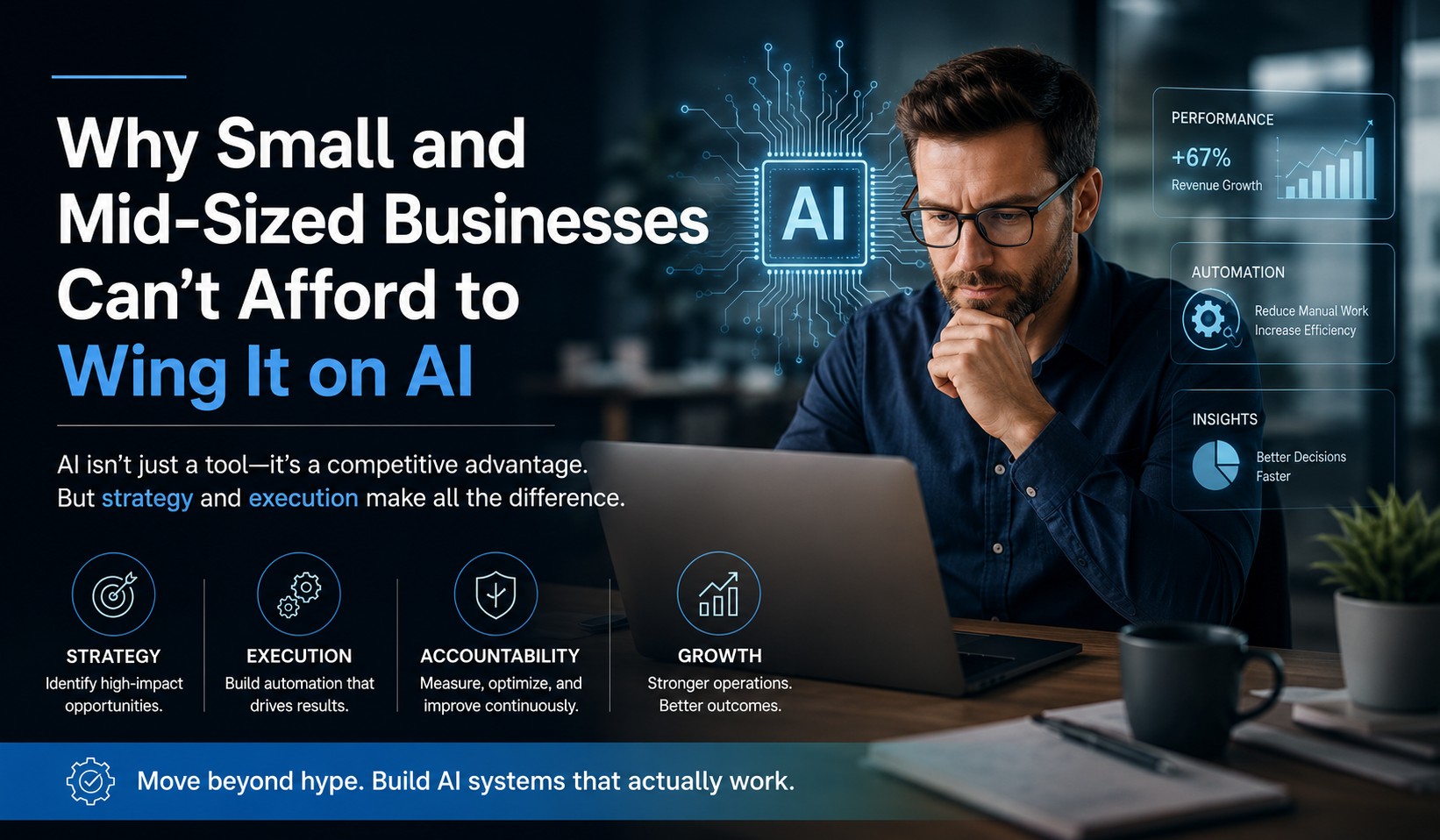
Small and mid-sized businesses often rely on outdated routines, manual workflows, and disconnected tools that don’t work together. The fear or hesitation is costing those businesses. On the other side, some companies have made deliberate moves towards AI adoption. Not by chasing every new product launch, but by building a coherent strategy and executing it with expert guidance.
The numbers are not subtle. According to McKinsey’s 2025 research, 72% of companies now use AI in at least one core business function. Up sharply from 55% just two years prior. Among small businesses deploying AI automation, 67% reported revenue growth of 20% or more; not by acquiring new customers, but by stopping the leaks in the ones they already had.
The uncomfortable part? The businesses seeing those results are not necessarily better-resourced. They simply picked the right problems to solve first and had the right expertise to solve them.
In this post, we’ll demonstrate the importance of leveraging support in pursuing and implementing AI adoption.
Let’s take the first real step.
Most small and medium enterprises already know that AI matters. The headlines have been clear; in fact, every other article now shows the benefits and valid concerns regarding AI adoption. In a recent post, we explored how workflows improved with AI tools. The problem is the gap between awareness and efficient execution, and it’s much wider than it appears.
Three barriers consistently stop SMBs from. They include: security and data privacy concerns, lack of time and internal resources, and unclear ROI. While these aren’t irrational fears, they are legitimate friction points that stop well-intentioned exploration from becoming a real business transformation.
But the harsher truth is that layering AI tools onto existing processes without strategic redesign doesn’t solve those problems; it compounds them. According to McKinsey, workflow redesign (how your team actually works) is the single highest-impact variable. The lesson here is that if you automate a broken process, you get a faster broken process. The real value of AI comes from rewriting how your company runs, not from adding subscriptions to the tech stack.
In simple terms, this is why working with an experienced AI consulting partner changes that outcome.
What does the word “strategy” mean for SMBs?
This means assessing where you are, identifying where AI creates the most leverage, sequencing the work intelligently, and building systems your team will actually use. Where you start is the key to your success.
Before a build starts, there must be a structured discovery process. Examining current workflows, data maturity, your team’s capacity, and where the real operational drag lives. Namely, the slow spots, the gaps, and repetitive tasks that cost hours. Now, tool selection without a strategic context is costly. There are quite a few tools available to improve cross-business functions, and often the right answer for your business is rarely the most popular.
Moving into automation is where the hands-on work begins. We design automation systems tailored to your revenue model and not generic playbooks. Automation-specific projects tend to show results fastest. Taking a direct approach to what the turnaround could look like is crucial. It is important not only to be specific about what that looks like but also not to wave around words like transformation.
The goal is to start with quick wins that show clear value and build confidence across the organization. Then, shift to high-impact transformation work with a team that has already seen what AI can deliver.That sequencing is intentional, and it’s how sustainable AI adoption actually happens.
The AI rush and do-it-yourself (DIY) path is real. There is much respect for folks who have the technical depth, bandwidth, and tolerance for a three to six-month learning curve to build functional AI solutions without outside help. But for most SMBs, that’s not the practical reality. When you’re the one running the business, you don’t have an entire quarter to spare for spending on testing and iterating on automation infrastructure that should already be working. This is also at the cost of selecting the wrong tool.
Here’s what an experienced consulting partner brings to the table:
Many creative agencies, like WDB Agency, have implemented solutions for so many organizations. From that, you develop a pattern library that no single organization can build on its own. You have seen CRM automation that looked elegant in a demo but collapsed under the volume of real data. Chatbots that worked beautifully in testing but then frustrated real customers in production. Now that accumulated experience means fewer wrong turns, faster diagnosis of what a business actually needs versus what it thinks it needs.
For SMBs, this pattern recognition alone can compress months of trial and error into weeks of focused execution.
We all know that every organization develops blind spots over time. Some workflows aren’t questions, especially when they were built in-house. We understand that these habits don’t make internal teams less capable; it is a natural human thing to want to protect your work product.
Here’s the other side of this: when it comes to identifying where AI can genuinely transform operations, that internal lens can be a liability. An external partner with no stake in preserving the status quo will ask the difficult questions, challenge assumptions, and see the inefficiencies in the workflow that has become normalized.
Anyone can give advice, and without execution, that’s just a conversation. The difference with a consulting partner is that it comes with strategy, ownership, management, and measurement. Milestones are defined, outcomes are clear, and when something isn’t working, there is a process already enabled to diagnose and correct with timely precision. This is the unexpected gap that most SMBs fall into when they act independently with AI adoption. When something falls short, support is limited.
Before taking the next step consider this:
Businesses that are taking advantage of AI have moved with clarity by identifying their highest-leverage opportunities and executing them with expert guidance, rather than experimenting with tools that were never properly connected to their actual business problems.
Studies show that over 80% of companies using AI fail to move past the pilot stage and into real production value. This is not a technology problem but the absence of aligned workflows, clear governance, and implementation partners who understand what “working” looks like.
If you are ready to move your business forward with a structured AI strategy, the first step is a conversion. We offer a free AI strategy session with a focused discovery call where we assess your current operations, identify where AI creates the most leverage for your specific business, and outline what a realistic roadmap looks like.
No obligation, no boilerplate recommendations. Just a serious conversation about where your business stands and where an AI strategy can take it.
No obligation. No boilerplate recommendations. Just a serious conversation about where your business stands and where an AI strategy can take it.
Book your free AI discovery call.


Please complete the form below and one of our team members will be in touch shortly.