We hope you enjoy reading this blog post
If you need help with website or marketing, book a call with our team for a free 360° overview and actionable recommendations report. Book a call

If you need help with website or marketing, book a call with our team for a free 360° overview and actionable recommendations report. Book a call
The morning starts with a bustle and a large coffee. A quick scan of a few emails, maybe the Slack messages. You’ll find a scheduling conflict that quickly balloons into another email. While browsing, though, there is a missing document and a vendor question. After several sips, the coffee is cold, so a quick warm-up, then a team check-in. Before you know it, it’s almost lunchtime and the actual work- you know, the revenue-generating, business-growing, client-serving work hasn’t started yet.
There is nothing wrong with making sure things are a bit buttoned up. This doesn’t define the week, even though this probably looks like a typical Monday morning. But most of that takes up quite a bit of time.
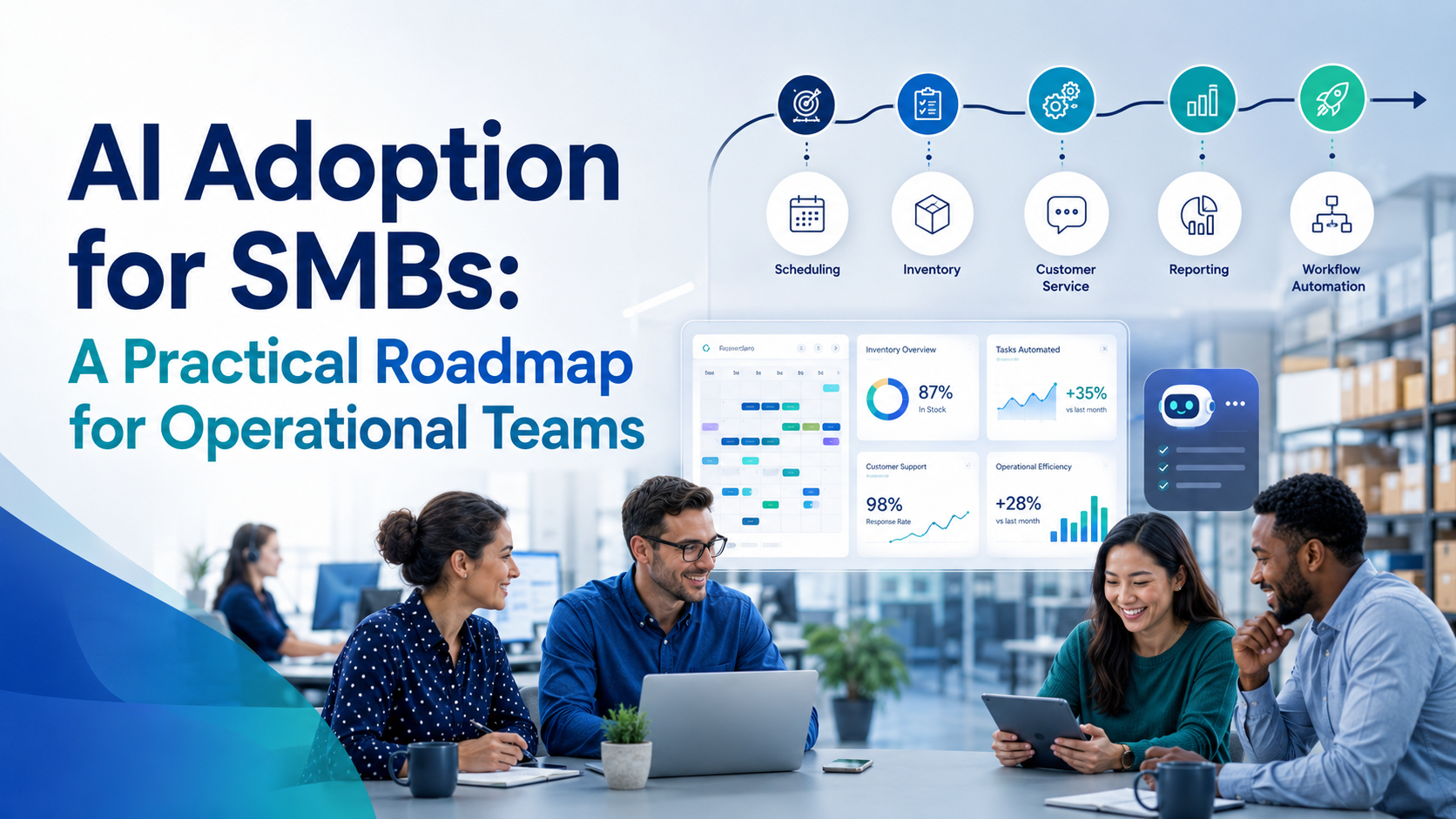
For most small and medium-sized businesses, the daily operational grind is both the engine that keeps things running and the ceiling that keeps them from growing. Routine is necessary. But unchecked, routine becomes expensive. It is the reason a good idea sits in a notebook, a growth initiative stays on a whiteboard, and the business plateaus not from lack of ambition but from a lack of bandwidth.
Artificial intelligence (AI) is being positioned to answer all of this. But the path from “I know AI could help us” to “AI is actually working in our business” is where most SMBs lose their footing.
Let’s examine this further.
Let’s look at the numbers. They tell a clear story. According to the U.S. Chamber of Commerce, 58% of small businesses now use generative AI, up from 40% the previous year. The SBA reports that the adoption gap between small and large enterprises has shrunk, and 96% of small business owners say they plan to adopt emerging technology, including AI, in the coming years.
The obvious momentum is building. But there’s a gap between intent and execution. Only 27% of small businesses feel confident about adopting AI effectively, while 61% say they lack a clear vision and plan for implementation. Meanwhile, 51% describe themselves as ‘AI explorers’, mostly testing tools without commitment, and still unsure whether the benefits justify going further.
This is decision paralysis, and it isn’t about lack of options. It’s about an overabundance of them, paired with genuine concerns that most AI marketing conveniently glosses over.
We covered the nuts and bolts of workflow automation in How Small Businesses Are Using AI to Build Smarter Workflows and Scale Faster, and the strategy-to-execution roadmap in Boston AI Consulting for SMBs: From Strategy to Execution. This post addresses the question that comes before all of that: why is it so hard to just start?
Company loyalty is one of the most powerful assets a small business has. For SMBs outside major metropolitan cities, like the regional distributor, the specialty manufacturer, the family-run logistics company, the team isn’t just a workforce. This is a community. People have been there for generations. Their children play on the same sports teams. So, replacing them with software isn’t just a business decision; this feels like a betrayal.
This concern is both valid and, in most cases, based on a misconception about how operational AI actually works.
Job security is a real fear, and the headlines aren’t much help. Most include enterprise sales restructuring at companies with thousands of alleged redundant roles, and the numbers keep growing. For an SMB, this math might look different. A 20-person operations team doesn’t have the redundancy that triggers mass displacement. What they have is a collection of individuals doing too many things. Some of which are genuinely valuable, and some are repetitive, low-stakes tasks that erode their capacity to do the valuable work.
AI adoption for SMBs shouldn’t eliminate people. To function as a successful AI-integrated company, human oversight isn’t optional; it’s required. The goal isn’t fewer employees. It’s the same employees doing higher-value work, with more of their time focused on what actually grows the business.
There is no right answer to this. There is no significant shift that signals the right conditions for knowing when to start. But there is a readiness threshold. A point at which a business has enough operational clarity to benefit from AI without it creating more chaos than it solves.
This requires a clear understanding of where time, money, and energy are leaking out of the business. That question, when answered honestly, is usually enough to get you started.
AI adoption also means that your team is supportive. Teams that feel consulted rather than informed, and whose role changes are examined rather than announced, adopt AI far more successfully than those who receive new software without context.
When this happens, it is a clear indication of trust and communication. Redefining job roles is not about punishment. It is the mechanism by which AI creates sustainable value. When a team member who spent 30% of their time on an intake document is freed from that task, the question becomes: What do we ask them to do with that 30%? This answer requires intention and leadership, not something an app can figure out on its own.
The question SMBs can start asking is, “What can we start doing that we’ve been putting off?” There is also a new market opportunity, a second service line, client onboarding overall, a content strategy that never launched, and a sales process that was redesigned in theory but never implemented in practice.
These aren’t dead ideas, only deferred ones. This is where AI creates a category of value that goes beyond efficiency: it creates capacity for growth that was previously out of reach. When repetitive operational work is handled, human attention can be redirected toward the growth initiatives that were always waiting.
Understanding the Real Trade-Off between using an app and a partner
Most applications are tools, not solutions. Applying a tool to an unclear process produces more confusion, not better outcomes. The app route is appealing: low cost, fast to deploy, and no contract. The consulting partner route feels heavier: a process, a sprint, and a budget. So why would anyone choose a slightly harder path?
Here’s an honest look at the landscape:
| Category | Tools | Best For |
| Productivity & Communication | Microsoft 365 Copilot, Google Workspace Gemini | Summarizing meetings, drafting emails, basic scheduling |
| CRM & Sales | Salesforce Agentforce, HubSpot AI | Lead scoring, pipeline visibility, follow-up automation |
| Marketing & Content | Jasper AI, Copy.ai | Social content, ad copy, email drafts |
| General AI Assistants | Claude, ChatGPT | Research, drafting, knowledge retrieval, internal Q&A |
These tools are increasingly accessible and useful. Especially for businesses with clear, contained use cases, like a marketing team that wants to produce content faster or a sales rep who wants AI-assisted CRM roles. The limitation appears at both the scale and operational levels. When a business wants to work across departments, connect to existing systems, maintain data privacy, and actually improve outcomes rather than just automating activity, bear in mind that embedded features are not a strategy. They are a starting point.
So what does working with a partner look like?
Did you know that 78% of organizations that successfully deeply AI worked with external partners for at least part of the implementation? The case for a consulting partner doesn’t mean that apps are bad. Apps don’t do strategic thinking, map workflows, or tell you which processes are ready for automation and which ones will break if you automate before fixing them. They don’t train your team, redesign your roles, or connect the dots between what the technology can do and what your business actually needs.
For operations-heavy SMBs, operational complexity means the gap between “deployed a tool” and “changed how we work” is the widest. A partner bridges that gap.
For operations-heavy SMBs — distribution, logistics, manufacturing services, specialty contractors, multi-location service businesses — the operational complexity means the gap between “deployed a tool” and “changed how we work” is widest. A partner bridges that gap.
Skepticism about AI is reasonable. The noise is enormous, the options are overwhelming, and the fear of getting it wrong or of disrupting the team that has been the backbone of the business is legitimate. The question isn’t whether AI belongs in your business. It’s whether you want to figure that out with a $30 app and no plan or with a structured process that builds toward something that actually lasts.
WDB Agency works with operations-heavy SMBs to identify, design, and implement AI workflows that reduce friction and unlock growth without disrupting the teams that keep the business running.
A discovery sprint is your best way to decide on your next step. Let us help you walk through it. Book your sprint now.


Please complete the form below and one of our team members will be in touch shortly.